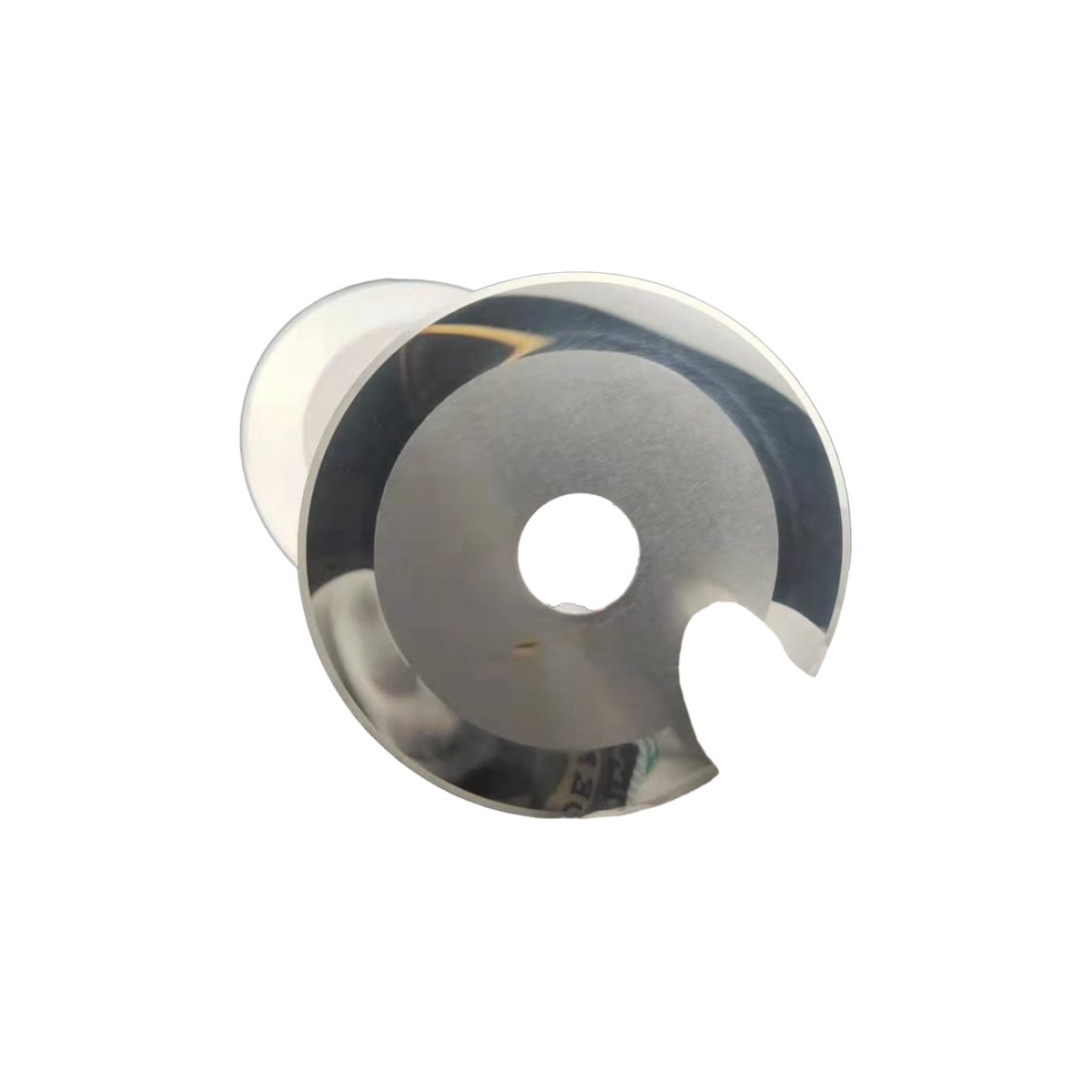
Key features
- Diameters from 30 mm to 610 mm, thickness 0.3–15 mm
- Concentricity held within 0.01 mm — no web wander at line speed
- Top / bottom knife pairs ground as matched sets
- TiN, TiAlN and DLC coatings for abrasive film and foil
- Cryogenic treatment: +20–30% edge life vs standard quench
Specifications
| Material | Cr12MoV, SKD-11 (D2), 9CrSi, HSS M2 / M42, solid tungsten carbide |
| Hardness | HRC 58–62 (tool steel); HRC 64–66 (carbide) |
| Outer diameter | φ30 – φ610 mm |
| Inner bore | φ10 – φ300 mm, H7 tolerance |
| Thickness | 0.3 – 15 mm |
| Thickness tolerance | ±0.002 mm (precision grade) |
| Concentricity | ≤ 0.01 mm |
| Flatness | ≤ 0.005 mm |
| Edge angle | 20° – 60° single or double bevel |
| Surface roughness | Ra 0.2 – 0.4 μm (mirror polished on request) |
| Heat treatment | Vacuum quench + triple temper, optional cryogenic −196 °C |
| MOQ | 1 pc (sample) / 10 pcs (batch) |
Applications
BOPP / PE / PET film slitting
Thin film converting and flexible packaging lines.
Aluminium & copper foil
Battery electrode and packaging foil slitting.
Paper & tissue rewinding
Slitter-rewinder top and bottom knives.
Tape & adhesive film
Clean burr-free edges on pressure-sensitive webs.
Blade types we make in this line
A partial list — if you do not see your blade, send us the drawing or a photo and we will confirm.
Fitting your machine, and buying a replacement
Our circular slitter knives are supplied as replacement blades for coil slitting and rewinding lines, including Dienes and Tidland slitting tooling, Kampf, Atlas and Goebel rewinders, and general-purpose film, foil, tape and paper slitting machines. Send the drawing, the machine brand and model, or a worn blade and we will match the outside diameter, bore, thickness and edge angle.
Also called: circular slitter blades · rotary slitter knives · top and bottom slitter blades · circular knife blade · slitting saw blade.
Materials used for this blade
Widely used, well understood grade. Good balance of cost and life.
Read the full grade guideLonger life than Cr12MoV at higher cost. The default upgrade.
Read the full grade guideEconomical and forgiving. Common for large straight knives.
Read the full grade guideM42 (cobalt) for heat resistance at very high line speeds.
Read the full grade guide