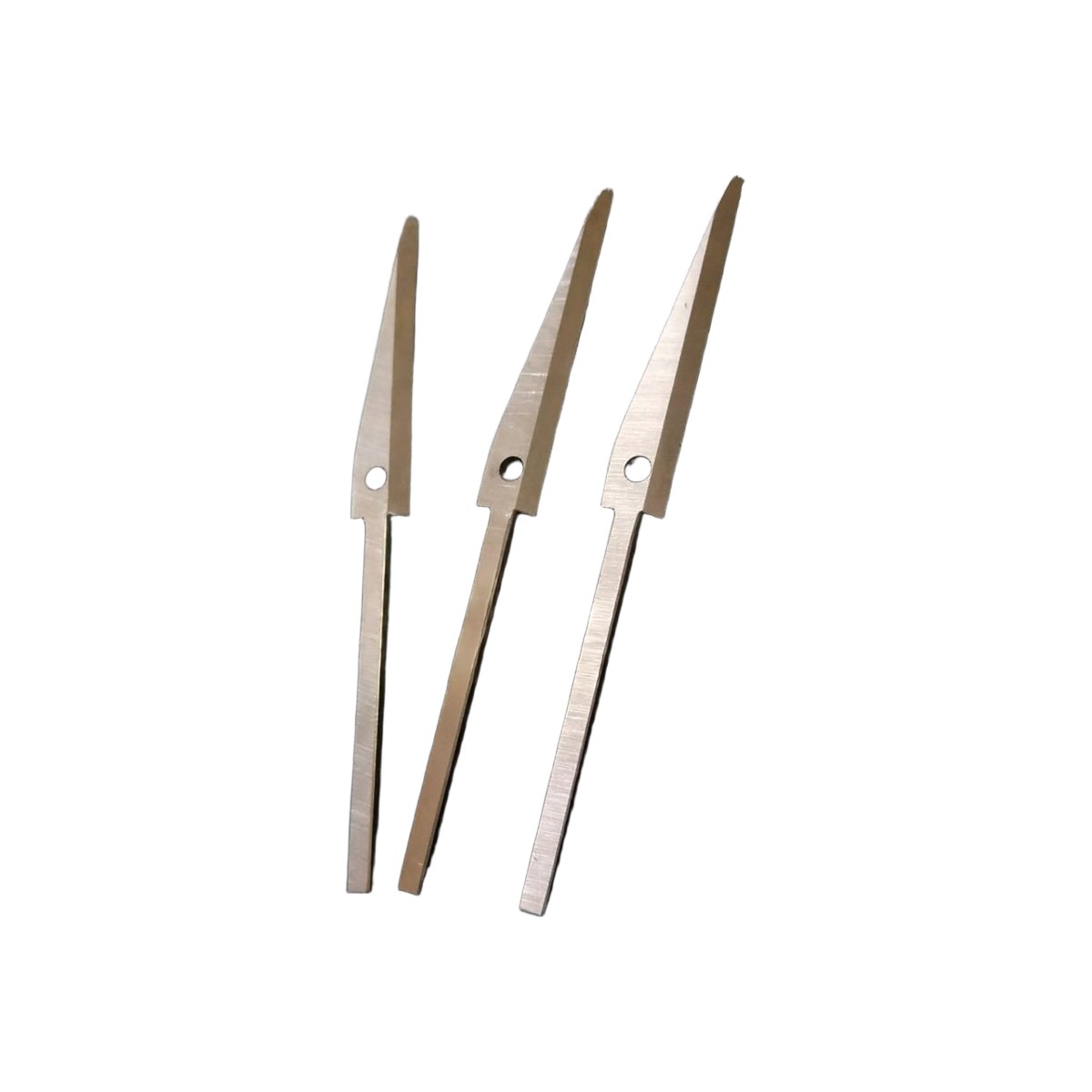
Key features
- Ultrasonic horn-matching blades and cold-cut knives
- 440C stainless: no rust in humid, wash-down mask rooms
- Edge held against abrasive PP / PET / nylon fibre
- Wave, straight and serrated edges for sealing and cutting
- Small batch friendly — non-woven lines change products often
Specifications
| Material | 440C, SKD-11, HSS M2, Cr12MoV |
| Hardness | HRC 54–58 (stainless); HRC 58–62 (tool steel) |
| Length | 30 – 800 mm |
| Thickness | 0.5 – 10 mm |
| Edge | Straight, wave, serrated, ultrasonic weld edge |
| Surface | Polished; anti-stick coating option |
| Tolerance | Length ±0.05 mm; edge straightness ≤ 0.02 mm |
| MOQ | 5 pcs |
Applications
Mask production lines
Ear-loop welding, folding and edge trimming blades.
Diaper & sanitary lines
Leg-cuff cutting and core shaping blades.
Non-woven converting
Roll slitting and sheet cutting.
Ultrasonic cutting stations
Horn-matched blades for sealed edges.
Blade types we make in this line
A partial list — if you do not see your blade, send us the drawing or a photo and we will confirm.
Fitting your machine, and buying a replacement
Blades and welding rolls for mask machines, hygiene production lines and non-woven converting equipment. Ultrasonic welding tooth rolls are made to the pattern drawing; the tooth height and pitch decide the bond strength, so we do not change them without your approval.
Also called: mask machine blades · hygiene machine knives · nonwoven slitting knives · ultrasonic welding rolls · melt-blown fabric slitting knives.
Materials used for this blade
Widely used, well understood grade. Good balance of cost and life.
Read the full grade guideLonger life than Cr12MoV at higher cost. The default upgrade.
Read the full grade guideM42 (cobalt) for heat resistance at very high line speeds.
Read the full grade guideRust-free. Required wherever blades see water and cleaning.
Read the full grade guide