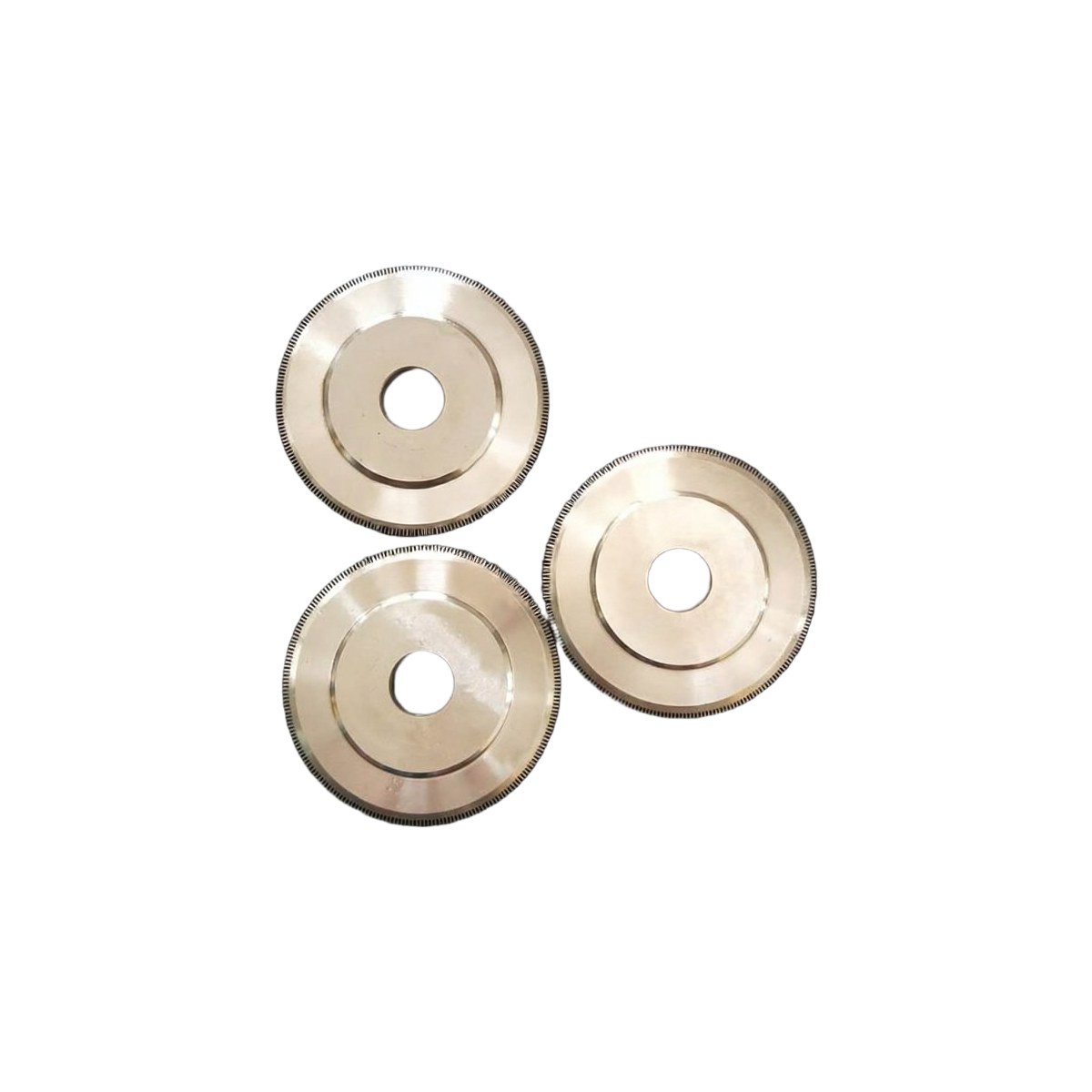
Key features
- Zig-zag, saw-tooth, wave and micro-perforation patterns
- Tooth pitch from 0.8 mm, held within ±0.02 mm
- No burr on the tear line — this is what decides whether the pack opens cleanly
- Hardened and tempered for repeated perforation at line speed
- Sample-first policy: we cut your film before shipping
Specifications
| Material | SKD-11, Cr12MoV, HSS M2, 440C stainless |
| Hardness | HRC 56–62 |
| Length | 30 – 1,500 mm |
| Width | 8 – 80 mm |
| Thickness | 0.5 – 6 mm |
| Tooth pitch | 0.8 – 12 mm (custom) |
| Tooth depth | 0.3 – 5 mm |
| Tolerance | Tooth pitch ±0.02 mm; overall length ±0.05 mm |
| Profiles | Zig-zag, saw-tooth, wave, scalloped, micro-perforation |
| MOQ | 5 pcs |
Applications
Easy-open food packaging
Tear notches and rip lines on snack and confectionery packs.
Pharmaceutical sachets
Tamper-evident perforation and opening aids.
Tissue & hygiene
Perforation between sheets on roll products.
Non-woven & textile
Clean cutting of hygiene products and technical textiles.
Blade types we make in this line
A partial list — if you do not see your blade, send us the drawing or a photo and we will confirm.
Fitting your machine, and buying a replacement
Toothed and serrated blades are ground tooth by tooth on a profile grinder, so the tooth pitch, height and rake angle can be changed without a new tool. We match the tooth form from the old blade or from a sample of the material being cut.
Also called: toothed knives · serrated circular knife · perforating blades · zigzag blades · toothed cutting blade.
Materials used for this blade
Widely used, well understood grade. Good balance of cost and life.
Read the full grade guideLonger life than Cr12MoV at higher cost. The default upgrade.
Read the full grade guideM42 (cobalt) for heat resistance at very high line speeds.
Read the full grade guideRust-free. Required wherever blades see water and cleaning.
Read the full grade guide