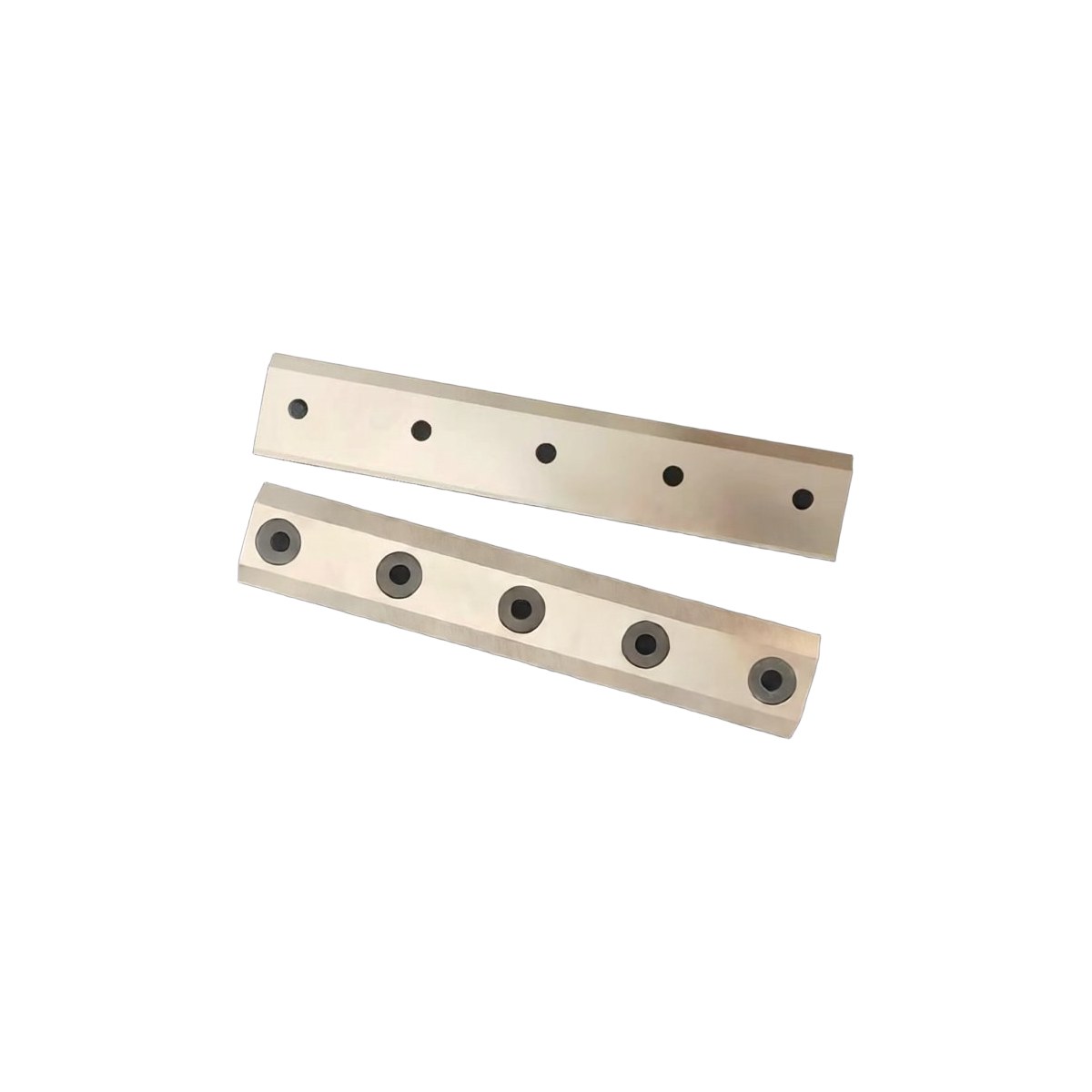
Key features
- Chipper, flaker, veneer and planer profiles
- Impact-tough grades: resists chipping on nail and knot strikes
- Lengths up to 1,500 mm, straightness within 0.1 mm/m
- Double-edged versions for twice the service life
- Matched sets balanced for high-speed cutter heads
Specifications
| Material | Cr12MoV, 6CrW2Si, 5CrW2Si, HSS M2, SKD-11 |
| Hardness | HRC 54–60 (impact grades); HRC 60–64 (wear grades) |
| Length | Up to 1,500 mm |
| Width | 30 – 250 mm |
| Thickness | 3 – 30 mm |
| Straightness | ≤ 0.1 mm / m |
| Edge angle | 30° – 45° (chipper); 35° – 40° (planer) |
| Balance | Set-balanced within ±2 g for high-speed heads |
| MOQ | 5 pcs or 1 set |
Applications
Drum & disc chippers
Wood chip production for pulp, board and biomass.
Veneer peeling lines
Peeling and clipping knives for plywood.
Planer & moulder
Furniture and joinery surface finishing.
Flaker & refiner
OSB and particleboard flake production.
Blade types we make in this line
A partial list — if you do not see your blade, send us the drawing or a photo and we will confirm.
Fitting your machine, and buying a replacement
Chipper knives, planer blades, veneer slicer knives and wood crusher blades. Chipper knives are the ones that fail by chipping rather than wear, so the steel choice is driven by what is in the wood — nails in reclaimed timber, knots in plantation logs, grit from the yard.
Also called: chipper blades · woodworking knives · planer blades · veneer slicer knives · wood crusher blades.
Materials used for this blade
Widely used, well understood grade. Good balance of cost and life.
Read the full grade guideLonger life than Cr12MoV at higher cost. The default upgrade.
Read the full grade guideChosen when chipping is the failure mode, not wear.
Read the full grade guideM42 (cobalt) for heat resistance at very high line speeds.
Read the full grade guide